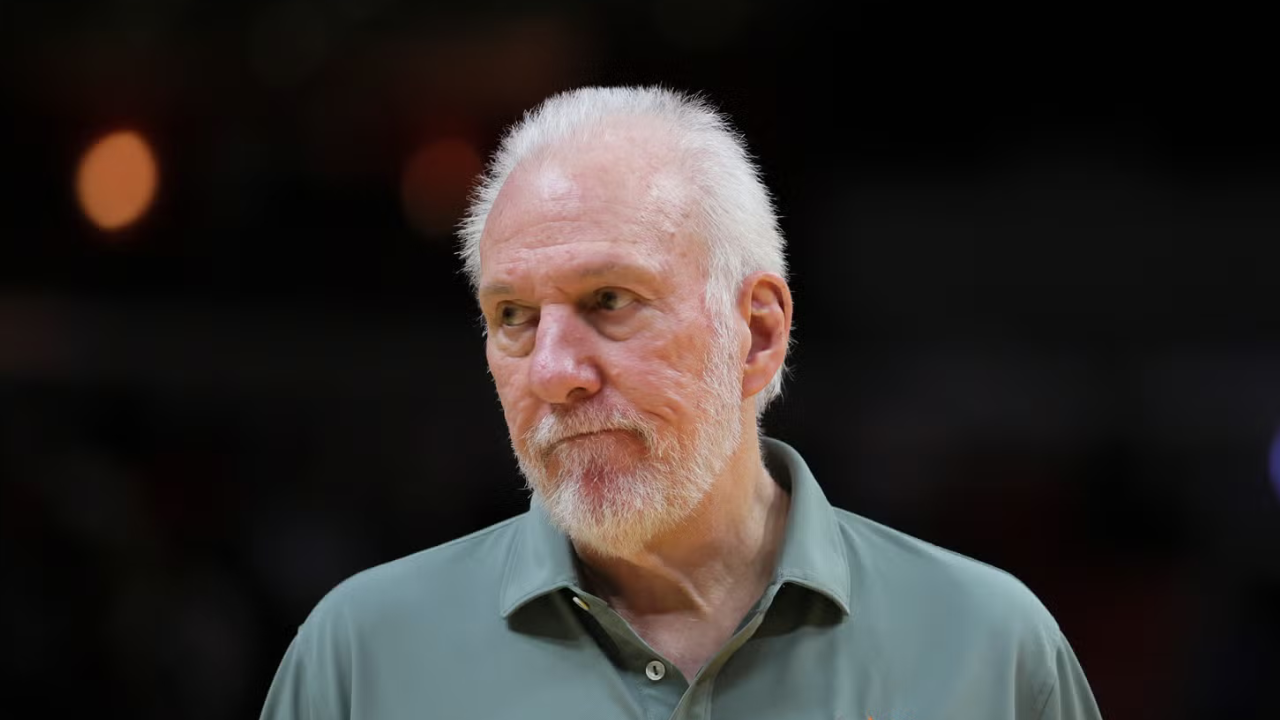
Gregg Charles Popovich was born on January 28, 1949, in East Chicago, Indiana, to a Serbian father and Croatian mother. Wikipedia From modest Midwestern beginnings, he would go on to build one of the most extraordinary careers in the history of professional sports — not only as a championship-winning coach, but as a profound leader, mentor, and advocate whose influence extended far beyond the basketball court.
Early Life and Military Service
Popovich attended Merrillville High School, graduating in 1966, before enrolling at the United States Air Force Academy, where he played on the Air Force Falcons men’s basketball team. In his senior year, he served as the team’s captain and leading scorer, graduating in 1970 with a bachelor’s degree in Soviet studies. Wikipedia These formative years instilled in him a discipline and sense of purpose that would define his entire coaching career.
After graduation, he served five years in the U.S. Air Force, during which he toured Eastern Europe and the Soviet Union with the U.S. Armed Forces Basketball Team, eventually being selected as team captain and winning the Amateur Athletic Union Championship in 1972. NBA Coaches Association During his time as an assistant coach at the Academy in the years that followed, Popovich earned a master’s degree in physical education and sports sciences from the University of Denver. Wikipedia
Building the Coaching Foundation
Before he ever set foot on an NBA sideline, Popovich paid his dues the hard way. In 1979, he was named head coach of the Pomona-Pitzer Sagehens, the joint men’s basketball team of Pomona College and Pitzer College in Claremont, California, leading the team to its first outright title in 68 years during his tenure from 1979 to 1988. Wikipedia
Those years at the Division III level were formative. Long before the days of easily accessible highlight reels, Popovich penned lengthy, personalized handwritten notes to recruits, discussing their on-court goals and academic ambitions — a sign of the personal investment in people that would become his coaching hallmark. Substack During this period, Popovich also took a sabbatical season to serve as a volunteer assistant under legendary coach Larry Brown at the University of Kansas, deepening his basketball education. Wikipedia
After rejoining Brown as lead assistant with the San Antonio Spurs from 1988 to 1992, Popovich moved briefly to the Golden State Warriors as an assistant under Don Nelson before returning to San Antonio in 1994 as general manager and vice president of basketball operations. Wikipedia
Taking the Helm in San Antonio
What happened next would become one of the most audacious and consequential decisions in NBA history. In December 1996, then-Spurs general manager Popovich fired coach Bob Hill after a dreadful 3-15 start to the season and inserted himself into the head coaching position. Substack It was a bold, unconventional move — but it worked beyond anyone’s imagination.
As head coach for 29 seasons from 1996 to 2025, Popovich won five NBA championships and became the longest-tenured active coach in the NBA as well as across all other major sports leagues in the United States. Wikipedia Those championship seasons came in 1999, 2003, 2005, 2007, and 2014, and along the way Popovich earned three NBA Coach of the Year Awards (2003, 2012, and 2014). NBA Coaches Association
Building a Dynasty Through People
What set Popovich apart from his peers was never just strategy — it was his extraordinary ability to build teams around shared values and human connection. Armed with lineups that included David Robinson and Tim Duncan, Manu Ginobili, Tony Parker, and Kawhi Leonard, and blessed with role players like Bruce Bowen, Sean Elliott, Robert Horry, and Avery Johnson, Pop blended his rosters of diverse personalities into cohesive championship units. Naismith Memorial Basketball Hall of Fame
Popovich was deliberate about building what he called “relationship excellence.” It started with recruiting players who were selfless and valued teamwork. He got involved in his players’ lives off the court, treating them as full human beings — not just performers. That kind of care built loyalty, psychological safety, and an environment where players gave their all. Arbinger
At the core of his coaching philosophy was an unwavering emphasis on teamwork, selflessness, and the collective success of the team over individual accolades — cultivating a culture that valued character, work ethic, and a team-first mentality. Coachstat This approach allowed players from vastly different backgrounds to thrive together across three decades of sustained excellence.
Adaptability and Longevity
One of the most remarkable aspects of Popovich’s career was his ability to evolve. From the defensive-minded teams of the early 2000s to the more fluid, offense-oriented squads of later years, Popovich demonstrated a remarkable capacity to adjust his coaching style and game strategies to suit the changing dynamics of his team and opponents. Coachstat
Popovich led the Spurs to a winning record in each of his first 22 full seasons as head coach, surpassing Phil Jackson for the most consecutive winning seasons in NBA history. Wikipedia Such consistency across roster changes, generational shifts in playing style, and the relentless evolution of the NBA is virtually unparalleled in professional sports.
Beyond Basketball: Advocacy and Character
Popovich was never content to be merely a basketball coach. He is widely respected for his advocacy, emotional intelligence, respect for humanity, and support for mental well-being — whether pausing a press conference to check in on a reporter’s family, giving a player a day off for personal reasons, or emphasizing humanity within his team dynamics, always leading with compassion and a “people-first” approach. My Site
On multiple occasions, Popovich spoke out on behalf of social justice issues, expressed support for the 2017 Women’s March, and repeatedly criticized political figures he believed were acting against the country’s best interests. He has also spent considerable time and money working with charities such as the San Antonio Food Bank and the Innocence Project. Wikipedia
Olympic Glory and Hall of Fame Induction
Popovich’s impact extended beyond the NBA. He also won a Gold Medal coaching the U.S. national team at the 2020 Tokyo Olympics and a Bronze Medal as an assistant coach at the 2004 Athens Olympics. NBA Coaches Association In 2023, Popovich was inducted into the Naismith Memorial Basketball Hall of Fame Wikipedia — a fitting tribute to a career that had redefined what coaching excellence looks like.
A Legacy That Transcends Wins
On November 2, 2024, Popovich suffered a stroke and took an indefinite leave of absence from the team. On May 2, 2025, the Spurs announced that he would step down as head coach after 29 seasons and transition to the role of president of basketball operations. Wikipedia
His coaching tree alone stands as a testament to his influence, producing the likes of Steve Kerr, Mike Budenholzer, Monty Williams, Mike Brown, and trailblazer Becky Hammon Naismith Memorial Basketball Hall of Fame — coaches who have carried his principles into organizations across the league and beyond.
His 1,422 victories and five NBA championships make him one of the most successful coaches in the history of professional sports — but they aren’t his real legacy. Gregg Popovich’s true legacy lies not in his record, but in how he built it: by creating a culture rooted in selflessness, deep connection, and shared responsibility. Arbinger
Gregg Popovich is more than the winningest coach in NBA history. He is a model of what it means to lead with integrity, humility, and genuine care for the people around you — a standard that will inspire coaches, leaders, and teams for generations to come.